
-
Meeting the Crew and Preparing the Yacht

As usual, the adventure started with meeting the crew and a short round of introductions. Our food delivery failed, so we simply switched to Plan B: shopping on the spot. The shopping list was ready, and while the crew took care of the provisions, I took over the yacht. After the obligatory safety briefing, we discussed our wishes and possible route. One destination was already clear: the famous black pigs of Atokos.
-
Ithaca — Our First Night

The next morning we cast off and headed towards Ithaca. Our general rule for the week was simple: go with the wind. We wanted a mixture of quiet bays and lively Greek towns, so we started with the quiet side. We anchored in Sarakiniko Bay, about two kilometres from Vathy, and secured the yacht with anchor and shore lines in a side wind. No problem for the crew. Then came the first long-awaited jump into the water.
After a glass of wine, we walked into Vathy and quickly realised how good our anchorage was. The wind had created a horrible standing wave inside the bay, while our little corner remained calm. Dinner was grilled octopus — a perfect end to the first sailing day.
-
Atokos — The Famous Black Pigs

Our next target was Atokos. As we approached the famous pig beach, it became obvious that we were not the only ones with the same idea. The bay was packed with yachts. We anchored well outside and sent a landing crew ashore to visit the pigs while I stayed with the yacht and kept an eye on the anchor.
The pigs were as cute as expected. After a while the crowds started disappearing, leaving us with enough space for a relaxed swim and lunch before continuing to Kastos.
-
Kastos — A Quiet Bay and a Greek Evening

In Kastos I picked a quiet bay opposite the main town, hoping to find some solitude. Five yachts eventually had the same idea, but it was still peaceful enough. In the evening we went ashore, stopped at a beautiful old windmill for cocktails and then enjoyed dinner in a local restaurant.
-
Meganisi — A Little Taste of Greece

Bad weather was approaching from the south, so we moved to Meganisi. This time we wanted civilisation — and water for the yacht. We found a free place in Odyssey Marina and parked ourselves. The marinero seemed slightly surprised, but everything worked out perfectly.
We walked to Katomeri, a small and authentic Greek town. There I became fascinated by two local ladies weaving towels and ended up buying one. In the evening we enjoyed gyros — not as fast street food, but as a proper local meal.
-
Lefkada — White Cliffs and an Empty Bay

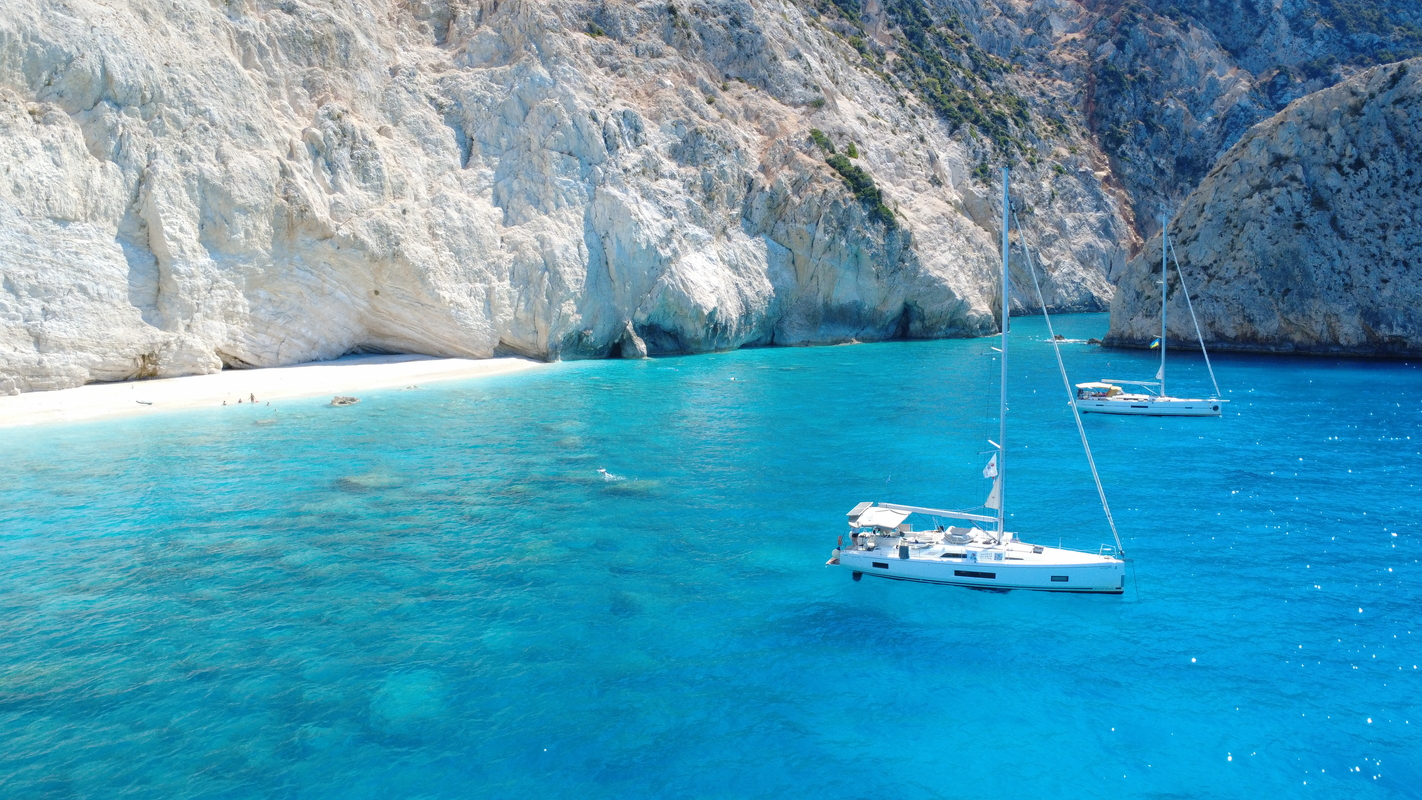
The next day's easterly wind was perfect for exploring the western side of Lefkada. We sailed towards Porto Medini, exploring several beaches along the way. The white cliffs were breathtaking — and even better, we were the only yacht there. It felt like a real escape from civilisation, and nobody wanted to leave.
But Fiskardo on Kefalonia was waiting for us, so eventually we continued north. I had hoped to find a place in the town pontoon. That was rather optimistic: the bay was packed with charter yachts. We anchored outside instead and went ashore to enjoy the lively town, some shopping and gyros.
-
The Dinghy Adventure

On the way back to the yacht we had our little adventure of the day. Halfway through the dinghy ride, we ran out of petrol. Fortunately, we had a paddle. It was a long but steady trip back to the yacht. After refilling the tank, I returned to pick up the rest of the crew.
-
Ithaca Again — Paralia Afales

After seeing the spectacular cliffs of Lefkada, we wondered where else we could find scenery like this. The answer was Paralia Afales on Ithaca. We expected it to be beautiful, but the reality was another big WOW. The cliffs, water and complete lack of crowds made it one of the highlights of the trip. We stayed as long as possible before finally setting sail again.
-
Mikros Gialos — Our Last Evening

For our final night we headed to Mikros Gialos Bay. After some work getting the anchor properly set, we were ready for the evening. We went ashore, took the rubbish to shore and enjoyed a relaxed dinner together.
-
The Final Morning

On our last morning we tried to enjoy every possible minute. There was swimming, SUP and a relaxed start before we had to return to the marina. We wanted to refuel before the entire charter fleet arrived after noon and created the usual chaos.
After filling the tank, we returned to the beach for some final swimming. And then came one last surprise: black pigs appeared on our beach too! The water was a little muddy and the place was nowhere near as spectacular as Atokos, but it was still a funny and memorable ending.
-
Until the Next Sailing Trip

Eventually we had to return to the marina. Since our diesel tank was already full, we could simply sail past the yachts waiting in the fuel queue. Some were not particularly happy about it, but they did not know that we had already taken care of our fuel.
And so our Ionian adventure came to an end. We had sailed through beautiful islands, discovered quiet bays and lively towns, enjoyed Greek food, met black pigs twice and collected plenty of stories along the way.
But the best part was something that cannot be planned on a route map: a group of people who had just met became a real crew — and then became friends. Hopefully, this was not our last week sailing together.
We had a fantastic week sailing through the Ionian Sea, combining quiet bays, beautiful islands, lively Greek towns and, of course, plenty of sailing. From Ithaca and Atokos to Kastos, Meganisi, Lefkada and Kefalonia, we followed the wind and adjusted our route to the weather and the crew's wishes. We discovered breathtaking white cliffs, swam in turquoise bays, met the famous black pigs twice, enjoyed local food and drinks, and even managed a small dinghy adventure when we ran out of fuel. Most importantly, somewhere between the first briefing and the final return to the marina, a group of people who had just met became a crew and, eventually, friends.
To complement this report, we have also created some videos capturing some of our favorite impressions from the journey.
-
Part 1 – Sailing to Jersey

On Saturday, we had a northwest wind of around 30 knots. We could have crossed the English Channel, but we would not have had enough time to return. So, we decided to sail to Jersey.
We started relatively early, with the staysail and two reefs in the mainsail. For the first two hours, we sailed against the wind. It was a bumpy ride, but we were still making more than 8 knots.
Then we reached the Race of Alderney. The current was in our favour, but the wind was still against us. This created very steep waves. At one point, a wave lifted the boat so much that I briefly felt weightless inside!
After passing the Race, the conditions improved. We changed to the Solent sail and reduced the reef in the mainsail. We were soon sailing at more than 10 knots towards Jersey.
We reached St Helier in time for high water and tied up for the night.
-
Part 2 – An Early Start from Jersey

During the night, we discovered that we had misjudged the depth at our berth. As the tide went out, the yacht touched the bottom.
For Sunday, we checked the wind and tides and calculated when we needed to leave to get back to Cherbourg in time. The decision was clear: we had to start at 7 a.m. After the previous evening, getting up that early was not easy!
Once we rounded the eastern end of Jersey, we set the spinnaker and sailed back towards France./p> -
Part 3 – Against the Current

On the way back, we reached the Race of Alderney about 30 minutes too late. This time, we had to deal with a strong current against us.
T The current was running at around 11 knots against the wind. We were sailing at 13 knots through the water, but our speed over the ground was only 1–2 knots. The waves slowed us down even more.
T This is a good example of how much the tides can affect your progress. Even when the boat is moving fast through the water, you may make very little progress towards your destination.
T Eventually, we passed Cap de la Hague and continued towards Cherbourg.
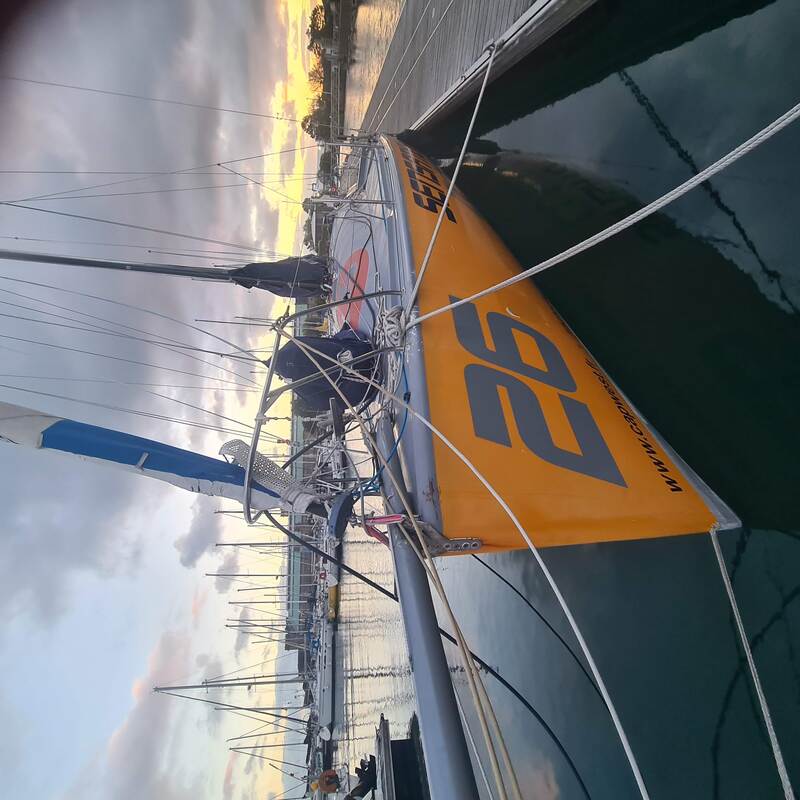
To be a confident skipper in normal conditions, I also need to train in difficult conditions. That is why I regularly join experienced racer and navigator Marc Lepesqueux for training on his Class40 yacht #26, Jumbo40.
During these weekends, we sail in tidal waters, practise sail changes, and use different sails, including the spinnaker and Code 0. We learn how to handle the boat and how to deal with changing weather and strong currents.
This time, we spent a weekend sailing in the English Channel. The wind and tides gave us plenty of things to practise.
To complement this report, we have also created some videos capturing some of our favorite impressions from the journey.